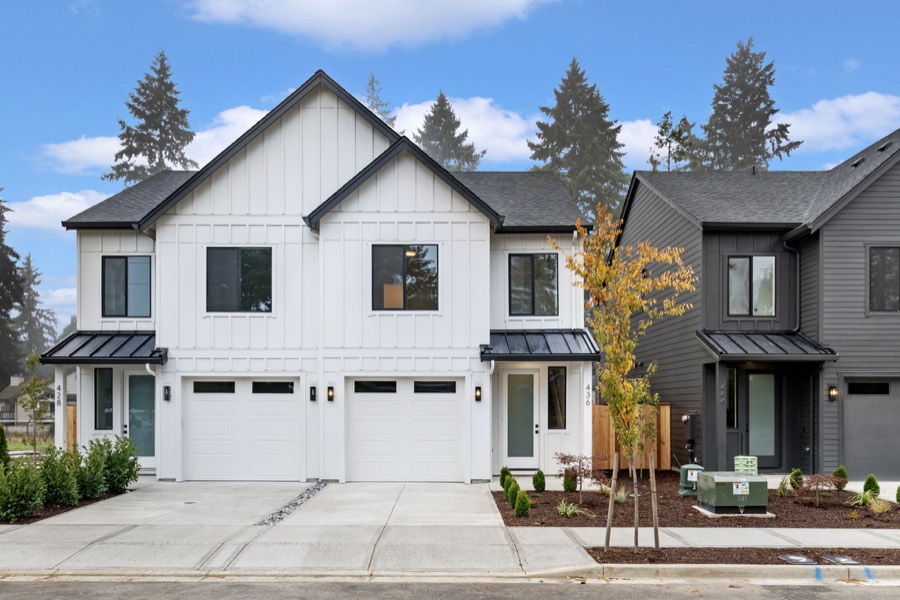
Arthur · 114 units
Location: Vancouver, WA
Farragut, Kenton, Ashley, Fircrest, Livingstone
Watch this project’s journey:
InstagramSee more on this project:
View the projectFinancing · Arthur the Developer
How the wrong construction loan setup quietly bleeds a deal, and the three areas we focus on to fix it.
Full guide: Financing →Most experienced investors treat the construction loan as fixed. You find a lender, you take the terms, you move on. That assumption is worth $50,000 to $100,000 a deal. Here is a real project, the Ashley build, a 3,420 square foot five bed 3.5 bath home on about a third of an acre, and every place the loan structure moves money.
Land $312,000, build cost roughly $600,000, so about $916,000 of total cost. Sale price around $1.5 million, netting roughly $1.4 million after agent fees and closing, so a gross profit near $486,000 before finance costs. Down payment at 13% is about $127,000. A 40% margin.
At 90% loan to cost the lender funds about $824,000 and you bring roughly $92,000. Find a lender who insists on 15% down and you bring closer to $137,000 for the identical deal. That $40,000 gap is capital you could have put into the next project. As long as the ROI is genuinely strong, 10% down plus 3% to 5% closing is the structure worth hunting for.
Pay $312,000 for land, spend $20,000 permitting it, and you are in at $332,000. If the bank appraises the permit ready lot at $400,000, you have created about $68,000 of equity. A lender who recognizes that reduces the cash you bring from $127,000 to about $59,000. On $916,000 of cost, that is 6.5% actually leaving your bank account, on an investment deal.
Some lenders set aside the full loan and charge interest on all of it from day one. At 10% on an $840,000 loan that is $84,000 a year, about $7,000 a month starting the day you close, on money you have not touched.
Structured on draw, your balance at closing is only the land portion net of your down payment, around $220,000, so about $2,000 a month. Then construction ramps slowly. Excavation runs about 5 days, the invoice arrives roughly 14 days later, and payment terms are 21 days, so you are 40 days into the project before you owe interest on a single construction dollar. Balances build from there: $40,000, then $80,000, then $110,000 as lumber is delivered and invoiced in stages, with the heavy costs (cabinets, electrical, HVAC, plumbing, flooring, paint) landing in the last 60 days. The full balance typically sits outstanding for only one to three months.
A lender offers to add $60,000 of interest reserve to your loan. It sounds like a service. It is an addition to your balance, and you pay interest on it, roughly $6,000 at 10%, on money sitting in their account instead of yours. Some also charge a fee to administer it.
Arthur declines it, or takes it as cash back at closing, or simply sets a slightly larger construction budget, say $650,000 against a $600,000 estimate, and makes the interest payments himself from cash on hand. If they charge $1,000 to manage the reserve, keep the money, set up autopay, and you are done.
That is the exact terminology. This one question is worth roughly $40,000 on a single family build.
Tell them you are working with multiple lenders. They usually land around 1.25, which is $8,000 saved on this deal. Range is $5,000 to $15,000.
They will say it is not. It is. Expect to knock off about $500 on a smaller deal.
Fold it into the closing as part of the points you are already paying. A 15 month loan becomes 18. Requesting it after the loan expires costs 2% to 3%.
A lender’s preferred title company might charge $3,000 where yours charges $1,800. Across a hundred transactions that is $120,000. Their team, their insurance, and their title company are recommendations, not requirements. You are the borrower, which means you hold the leverage.
Add it up on one single family build: $5,000 to $15,000 on points, about $500 on underwriting, roughly $1,000 on title, about $6,000 on interest reserve, and around $40,000 on the draw structure. Call it $40,000 to $60,000 on one house. On a $2.5 million multi-unit loan, the same negotiation is worth closer to $200,000.
Ready to stop watching and start building?
Join the BuildUp Challenge and book a call with our team.
Join the BuildUp ChallengeWatch more on Arthur's channel.
Taking a loan that charges interest on the full balance from day one rather than on draws. On the Ashley project, an $840,000 loan at 10% charged in full is about $7,000 a month starting at closing. Structured on draw, total interest came to roughly $42,500 instead of about $104,000.
Your balance starts at the land portion only, around $220,000 on that deal, and construction costs arrive slowly. Excavation takes about 5 days, the invoice lands 14 days later, and terms are 21 days, so you are 40 days in before owing interest on any construction dollar. The full balance is typically outstanding for only one to three months.
It is money the lender adds to your loan to cover your interest payments, which means you pay interest on it. A $60,000 reserve at 10% costs about $6,000 extra, on money sitting in their account. Decline it, take it as cash back, or budget slightly more construction and make the payments yourself.
With the right lender, yes. Pay $312,000 for land, spend $20,000 permitting it, and if the permit ready lot appraises at $400,000 you have created about $68,000 of equity. That can reduce cash to close from about $127,000 to $59,000, or 6.5% of total project cost.
Four things. Ask directly whether it is on draw. Push points from two toward one or 1.25. Ask for the underwriting fee to be reduced, because it is negotiable even when they say it is not. And fold a free 3 to 6 month extension into closing. You can also use your own title company instead of theirs.
Nationwide
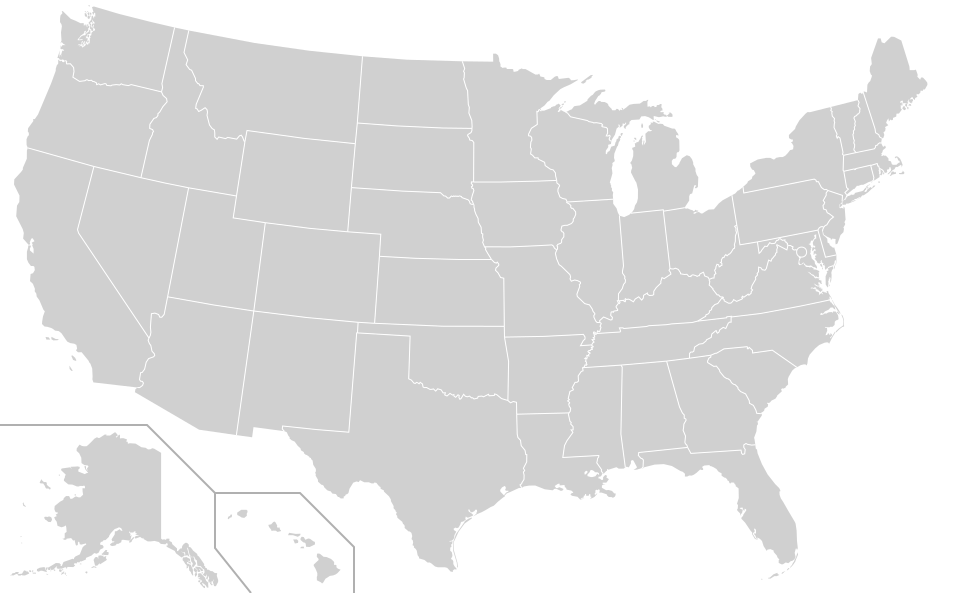
65+ active member builds, 300+ units in progress, across 20+ states. Click a market to see who is building there.
346
Units developing live
49
Markets
Location: Vancouver, WA
Farragut, Kenton, Ashley, Fircrest, Livingstone
Watch this project’s journey:
InstagramSee more on this project:
View the projectClick this market again for the next build here.
Your next step
New to development
A step-by-step challenge to line up your first deal, with our team beside you.
Join the ChallengeLive every week
Arthur and Ruben break down real deals and answer your questions in a live Q&A.
Join the live masterclassReady to build
Development consulting for people ready to put a real deal together now.
Explore consultingFree Resources
The templates, guides, and live sessions we hand every new member.
Real 2026 build costs for 43 US markets, from Arthur's own price map, with a live profit calculator.
Explore →Free PDFThe complete roadmap from land to sale, free.
Get it →Free AccessFree resources and every member story in one place.
Get it →Live WeeklyLive masterclass, weekly on Tuesdays. How to become a developer even with zero construction experience.
Get it →Free TemplateThe letter we use to reach lot owners directly, plus the training to use it.
Get it →Starter KitEverything you need to get moving on your first development, in one place.
Get it →Free CourseOur full 2.5-hour course on becoming a developer, land to exit, free on YouTube.
Get it →