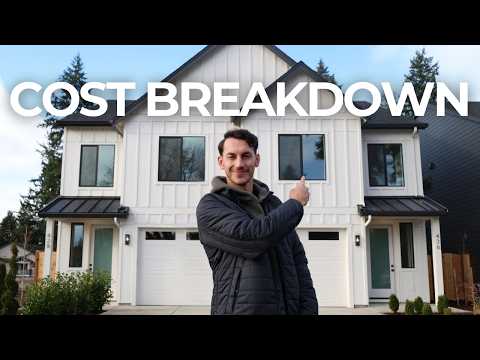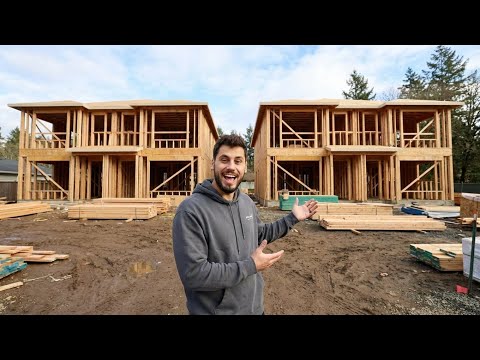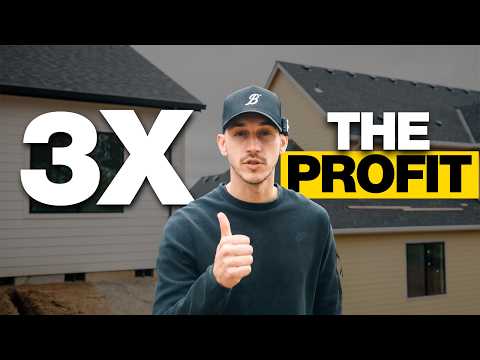
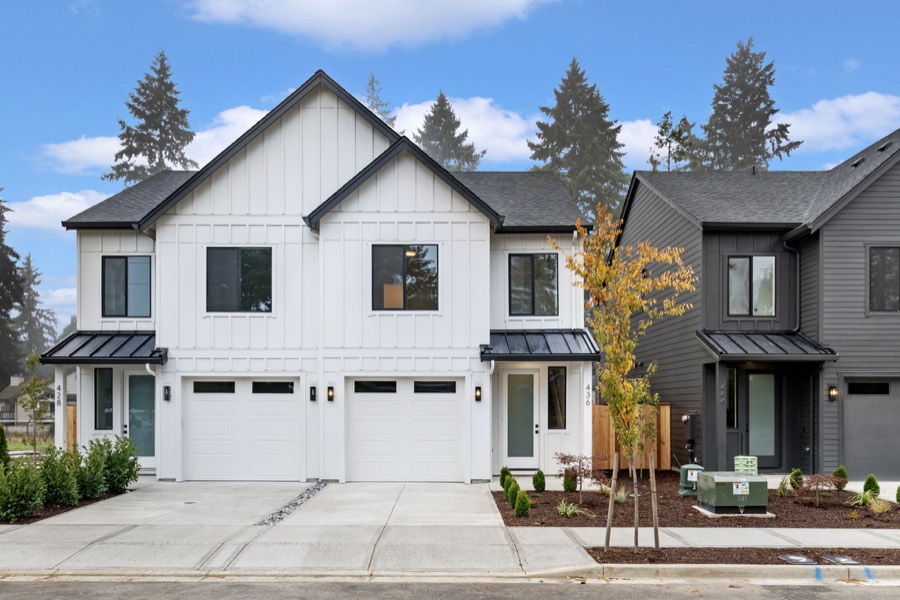
Arthur · 114 units
Location: Vancouver, WA
Farragut, Kenton, Ashley, Fircrest, Livingstone
Watch this project’s journey:
InstagramSee more on this project:
View the projectNumbers & Deals · Arthur the Developer
How we filter deals fast so we only spend real time on the ones that pencil for new construction.
Full guide: Numbers & Deals →Arthur walks away from 90% of the deals he looks at, and that is not failure, that is the system working. He has reviewed tens of thousands of properties and takes about one in ten. The skill worth learning is not how to find a great deal. It is how to kill a bad one in five minutes so the good ones get your energy.
Pull the lot up on a map, filter listings to 2020 or newer, and look. If there is zero new construction in the area, you are not going to be the one who proves it works. New construction happening nearby means builders are making a profit there. If a small town has nothing and a larger town 20 miles away is full of it, build in the larger town.
There is a floor built into the math: it costs roughly $100 to $175 per square foot to build. If homes in that market sell for $100 a square foot, there is no margin to be had at any level of skill.
What are people actually building? Mansions, duplexes, townhomes, a mix? The closer a comparable product sits to your lot, the better. If there is a duplex going up a block away and a large single family home further off, and your lot is next to the duplex, build the duplex. Someone already proved that product turns a profit there.
Always in that order, because 80% of deals die on price and only 20% die on utilities. Verifying utilities takes real time. Verifying whether the numbers work takes two minutes.
Worked example in a $100 per square foot market: a 2,000 square foot duplex sells for $400,000. Build is $200,000 plus a $10,000 builder fee, so $210,000 to $220,000. Take the $400,000, subtract 5% agent fees ($20,000), subtract a 20% margin off the gross ($80,000), and $300,000 remains for land plus construction. Subtract the $220,000 build and you have $80,000 for the land. If they are asking $150,000, you offer $80,000, and you might open at $75,000.
Water, sewer, power. A missing lateral for either water or sewer runs $5,000 to $10,000. If the water main stops 100 feet short of your lot, that extension might be $15,000, and that $15,000 comes straight off your land offer. Septic instead of public sewer is another $15,000 to $25,000. Stack a water extension and a septic system onto the example above and an $80,000 land number becomes $55,000, or the $70,000 profit gets cut in half. Most people never run that math and just start building.
Storm water is solvable, often with an infiltration trench that takes roof runoff into the ground. Gas is optional, since everything can be electric. Internet is not a constraint anymore. Water, sewer, and power are the three that decide it.
Multiply after build value by 20% to get your maximum land price, then subtract every cost required to make the lot buildable. Regional reality: about 10% in Missouri, 10% to 15% in Texas, 18% to 20% in the Pacific Northwest, and markets like San Jose can support 40%. Treat 20% as a maximum, not a target.
The example deal returns $80,000 on $300,000 of cost, a 26% ROI. Twenty percent is the hard floor and it can flex slightly lower only on a personal house, where you live in it and can sell tax free after two years under IRS section 121: up to $250,000 single, $500,000 married.
Filter new construction and compare active, pending, and sold in the last 90 days. Above a 25% pending to active ratio is healthy, and you want sold-in-90-days close to the active count. 150 active with 10 pending and 30 sold is an overbuilt market.
If a market looks saturated, go down a level. Filter to the specific product. If 20 duplexes are listed, 10 are pending, and 30 sold, that product is moving even if the market as a whole is not. Micro markets matter enormously. In Portland, being within a couple of blocks of retail, coffee, a park, and a school gets $400,000 per unit while the same product a mile away gets $250,000 to $300,000.
Around $120 to $170 in Florida depending on pocket and finish level, about $140 in Atlanta, $150 in Virginia, $160 to $170 in California, and $150 to $175 in Oregon and Washington. Anyone quoting $300 per square foot is either building a high end custom home or keeping the difference as profit.
Ready to stop watching and start building?
Join the BuildUp Challenge and book a call with our team.
Join the BuildUp ChallengeWatch more on Arthur's channel.
Three checks. Is new construction happening at all, filtered to 2020 or newer? Is the pending to active ratio above 25%? And is the count sold in the last 90 days close to what is currently active? 150 active with 10 pending and 30 sold is an overbuilt market.
Multiply after build value by 20% to get your maximum land price, then subtract every cost needed to make the lot buildable. It varies by region: about 10% in Missouri, 10% to 15% in Texas, 18% to 20% in the Pacific Northwest, and up to 40% in a market like San Jose. Treat it as a ceiling, not a target.
The numbers, always. About 80% of deals die on price and only 20% die on utilities, and verifying utilities takes far longer. Arthur can tell whether a deal pencils in about two minutes. Only then is it worth researching where sewer, water, and power actually run.
A missing water or sewer lateral runs $5,000 to $10,000. Extending a main 100 feet to reach your lot might be $15,000. Septic instead of public sewer is another $15,000 to $25,000. Every one of those numbers comes straight off what you offer for the land, and stacking two of them can cut a projected profit in half.
Filter down to the specific product before you write it off. If 20 duplexes are listed, 10 are pending, and 30 sold, that product is moving even when the market as a whole looks slow. Micro markets matter too: in Portland, being within a couple of blocks of retail, a park, and a school gets $400,000 per unit while the same product a mile away gets $250,000 to $300,000.
Nationwide
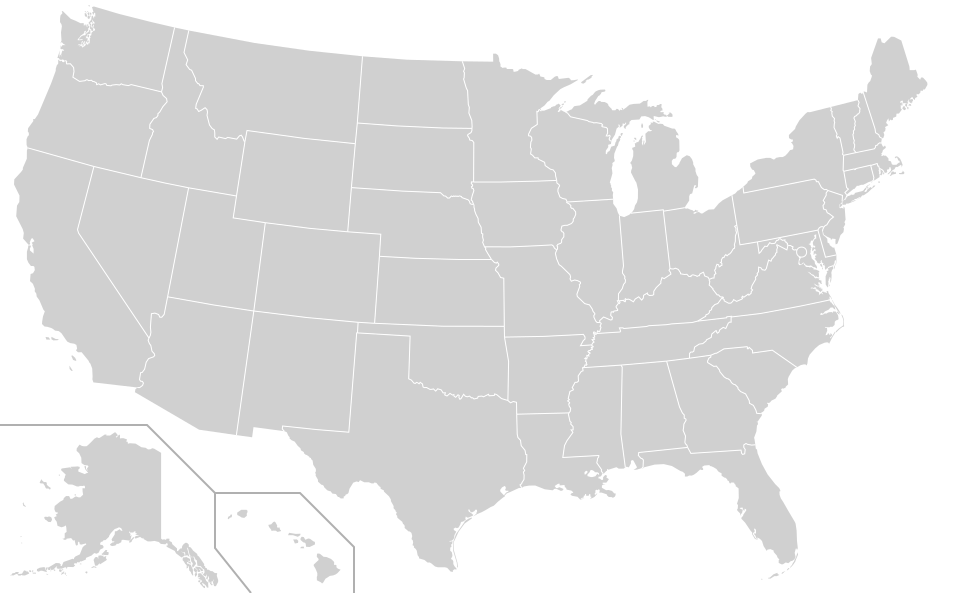
65+ active member builds, 300+ units in progress, across 20+ states. Click a market to see who is building there.
346
Units developing live
49
Markets
Location: Vancouver, WA
Farragut, Kenton, Ashley, Fircrest, Livingstone
Watch this project’s journey:
InstagramSee more on this project:
View the projectClick this market again for the next build here.
Your next step
New to development
A step-by-step challenge to line up your first deal, with our team beside you.
Join the ChallengeLive every week
Arthur and Ruben break down real deals and answer your questions in a live Q&A.
Join the live masterclassReady to build
Development consulting for people ready to put a real deal together now.
Explore consultingFree Resources
The templates, guides, and live sessions we hand every new member.
Real 2026 build costs for 43 US markets, from Arthur's own price map, with a live profit calculator.
Explore →Free PDFThe complete roadmap from land to sale, free.
Get it →Free AccessFree resources and every member story in one place.
Get it →Live WeeklyLive masterclass, weekly on Tuesdays. How to become a developer even with zero construction experience.
Get it →Free TemplateThe letter we use to reach lot owners directly, plus the training to use it.
Get it →Starter KitEverything you need to get moving on your first development, in one place.
Get it →Free CourseOur full 2.5-hour course on becoming a developer, land to exit, free on YouTube.
Get it →