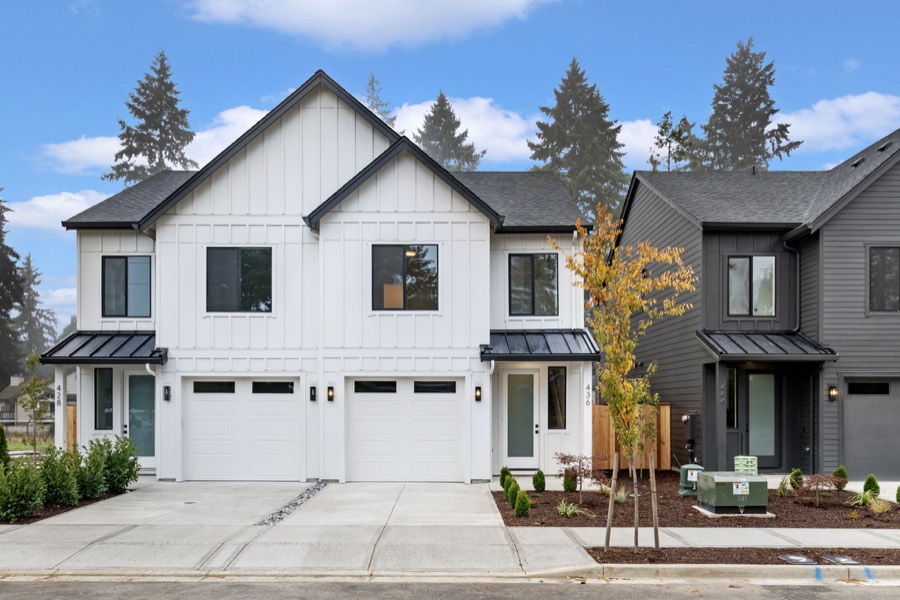
Arthur · 114 units
Location: Vancouver, WA
Farragut, Kenton, Ashley, Fircrest, Livingstone
Watch this project’s journey:
InstagramSee more on this project:
View the projectPersonal Home · Ruben the Builder
Ruben's math on buying versus building the same house in 2026, walked through the way we look at it as builders.
Full guide: Personal Home →Should you buy a home or build one in 2026? Most people answer this by comparing a purchase price to a construction cost and stop there. The comparison that matters is the all-in cost, the equity position on move-in day, and what you are actually buying into.
Take a $650,000 home on the market with 5% down. Run it through any mortgage calculator and the monthly payment is about $3,784. At a 43% debt to income ratio you need roughly $8,800 a month of income to qualify.
Build the same house and it costs about $500,000. The payment drops to about $2,911, and the income you need to qualify drops to about $6,770. Same house, same neighborhood, a $2,000 a month difference in what you have to earn to live in it.
Buy at retail and you absorb the lender fees, closing costs, and agent commissions on day one, which is what puts a buyer at negative equity the moment they get the keys. Build and you move in 20% to 30% positive. Not $10,000. Potentially $50,000, $100,000, or $200,000 of equity on the day you move in.
Most homes on the market carry something. So the buyer pays retail, carries a higher payment, sits at negative equity, and still has to reserve cash for the HVAC system, the appliances, or the flooring that starts to crack. A new build starts that clock at zero.
Across 250+ homes built and the projects run with members across the country, land runs 10% to 20% of final build value and varies entirely by market: $50,000 lots exist, and in denser areas it is closer to $100,000 and up.
Construction runs $100 to $250 per square foot with a spec builder, and material costs are roughly consistent nationwide. What moves the number is labor, permit fees, and soft costs, which vary by jurisdiction. Those figures include hard costs, the physical material and labor, and soft costs, the plans, permits, and paper.
Then the builder fee: 10% to 15% cost plus, so $50,000 to $100,000 on a $500,000 build. That covers managing the project, carrying his license on the permit file, finishing the home, and holding the insurance. If someone quotes a flat $200 plus per square foot, ask whether spec building is actually their business model, because a flat price with the profit built in invisibly is how your equity ends up on their side of the table.
Finally, carry costs: lender commission, interest during construction, and title or attorney fees, usually 5% to 7% of the construction budget. Interest is typically wrapped into the loan and treated as a line of credit, so it starts small (interest on just the $100,000 land draw) and grows as construction draws grow.
Both paths carry lender commission, title and closing costs, and interest. The difference is that one ends in positive equity and one ends in negative equity.
Buying means buying into someone else's design choices. Building means choosing a layout that is selling today.
New construction areas are usually up and coming, and historically appreciate slightly faster than an established resale.
Thirty days to move into a purchase, about 12 months to build. That is the real cost of building, and the equity is what you are paid for the wait.
Live in the home at least 2 of the last 5 years and the gain is exempt up to $250,000 filing single or $500,000 filing jointly. Buying at market price will never create $500,000 of equity in two years. A personal build at 5% down can. Ruben recently spoke with a 29 year old who had done this two or three times: live in it two years, sell it tax free, roll the profit into the next build. He was about to move into his fourth house, appraised at $1.2 million with a $200,000 loan balance.
Three tests. One, capital and patience: 5% to 7% down plus the income to qualify for a personal house, or 10% to 15% down on an asset-based loan if your income will not qualify, and 12 months of willingness to wait. Two, market: houses are being built and sold in your area, because builders do not build to lose money. Three, consistency: the temperament to push a project forward every day and not quit when it drags.
Ready to stop watching and start building?
Join the BuildUp Challenge and book a call with our team.
Join the BuildUp ChallengeWatch more on Ruben's channel.
Building. A $650,000 house on the market at 5% down carries about a $3,784 monthly payment and requires roughly $8,800 a month of income at a 43% debt to income ratio. Building the same house for $500,000 drops the payment to about $2,911 and the income needed to about $6,770.
Typically 20% to 30% on move-in day, so $50,000 to $200,000 depending on the price point. A retail buyer absorbs lender fees, closing costs, and agent commissions up front, which is what puts them at negative equity the moment they get the keys.
Land runs 10% to 20% of final build value. Construction runs $100 to $250 per square foot with a spec builder, including hard and soft costs. Add a 10% to 15% builder fee, so $50,000 to $100,000 on a $500,000 build, plus 5% to 7% of the construction budget in carry costs.
Because a flat quote usually has the builder's profit built into it invisibly, and that profit is your equity. Ask whether spec building is actually their business model. The builder you want charges cost plus a 10% to 15% fee, so you can see exactly what the house costs and what he makes.
Three tests. Capital and patience: 5% to 7% down plus income to qualify for a personal house, or 10% to 15% down on an asset-based loan, and 12 months of willingness to wait. Market: houses are being built and sold near you, because builders do not build to lose money. And the consistency to push the project forward every day.
Nationwide
65+ active member builds, 300+ units in progress, across 20+ states. Click a market to see who is building there.
346
Units developing live
49
Markets

Location: Vancouver, WA
Farragut, Kenton, Ashley, Fircrest, Livingstone
Watch this project’s journey:
InstagramSee more on this project:
View the projectClick this market again for the next build here.
Your next step
New to development
A step-by-step challenge to line up your first deal, with our team beside you.
Join the ChallengeLive every week
Arthur and Ruben break down real deals and answer your questions in a live Q&A.
Join the live masterclassReady to build
Development consulting for people ready to put a real deal together now.
Explore consultingFree Resources
The templates, guides, and live sessions we hand every new member.
Real 2026 build costs for 43 US markets, from Arthur's own price map, with a live profit calculator.
Explore →Free PDFThe complete roadmap from land to sale, free.
Get it →Free AccessFree resources and every member story in one place.
Get it →Live WeeklyLive masterclass, weekly on Tuesdays. How to become a developer even with zero construction experience.
Get it →Free TemplateThe letter we use to reach lot owners directly, plus the training to use it.
Get it →Starter KitEverything you need to get moving on your first development, in one place.
Get it →Free CourseOur full 2.5-hour course on becoming a developer, land to exit, free on YouTube.
Get it →