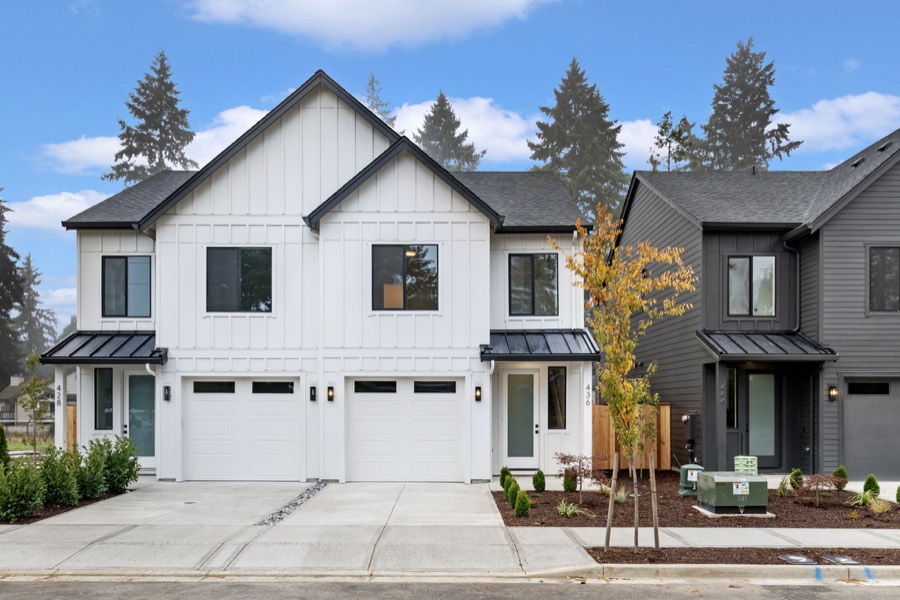
Arthur · 114 units
Location: Vancouver, WA
Farragut, Kenton, Ashley, Fircrest, Livingstone
Watch this project’s journey:
InstagramSee more on this project:
View the projectPersonal Home · Arthur the Developer
How a home equity line of credit actually works, and the moments where we would not touch our equity.
Full guide: Personal Home →You do not have to sell your home to use the equity in it. A home equity line of credit lets you pull that equity out, put it to work in a build, and pay it back without ever listing the house. Used correctly it is the cheapest money in the deal. Used incorrectly it behaves exactly like credit card debt.
The bank looks at your home’s value and your current mortgage, and lends against the gap in the form of a line of credit, closer to a checkbook than a loan. A credit card charges 20% to 30%. A HELOC is typically one or two points above the current mortgage rate, so about 8% when mortgages are at 6%, and you only pay when you actually draw on it.
Take a home worth $800,000 with a $500,000 mortgage, so $300,000 of equity. The bank will not lend all $300,000, because that would put your total debt at the full value of the house. They cap total debt, mortgage plus line combined, at 80% to 90% of value. At 90% that is $720,000, minus the $500,000 mortgage, so a $220,000 line of credit. The 10% they hold back is their safety cushion.
Draw $100,000 to buy a lot and at 8% you are paying $8,000 a year, roughly $665 a month. Set that against what $100,000 of down payment does on a build, which within 12 months should return 50% to 150% on the money down. You are paying $8,000 in interest to work $100,000 that is targeting $50,000 to $150,000 of return.
A HELOC is interest only. There is no principal in the payment, so whatever you borrow you keep paying on until you actually pay the balance down. That makes it wrong for two things: long term holds, and toys. Buy a rental you plan to keep 30 years, or a depreciating liability, and you have simply built yourself a very large credit card.
The right use is short term, 6 to 18 months. Borrow, pay your $8,000 of interest, pay the balance back, and the interest stops. If you do want a rental out of it, build, rent, stabilize, refinance to a 30 year mortgage, and pay the line back with the refinance.
Here is the play. A $100,000 lot with a $400,000 build, so $500,000 of cost against roughly $700,000 of value. The construction lender wants 10% down plus about 3% closing, so about $65,000, and they will not fund until permits are approved.
Draw $100,000 and buy the lot for cash. Your HELOC is cheaper money than the hard money lender's, so use it on the piece you can.
Roughly $10,000, drawn from the same line. Now you own an approved, permit-ready lot.
Ask the lender for $400,000 rather than the full $500,000, because your land is already paid for.
About $8,000 of HELOC interest and roughly $30,000 in construction loan fees and interest. On roughly $200,000 of gross profit, that nets around $125,000 with none of your own cash in the deal.
This is not theoretical. One member built a 3,500 square foot personal house and pulled a line of credit over $200,000 against it to keep going. Ruben pulled $290,000. Family members have pulled $550,000 and built a project that made about $400,000. Once you start running several at once, the growth stops being linear.
Ready to stop watching and start building?
Join the BuildUp Challenge and book a call with our team.
Join the BuildUp ChallengeWatch more on Arthur's channel.
A home equity line of credit. The bank looks at your home value and your current mortgage and lends against the gap as a line you draw from, like a checkbook. Rates run one to two points above the current mortgage rate, so around 8% when mortgages are at 6%, and you only pay interest on what you actually draw.
Banks cap total debt, mortgage plus line combined, at 80% to 90% of value. On an $800,000 home with a $500,000 mortgage, 90% of value is $720,000, minus the mortgage leaves a $220,000 line. The 10% held back is the bank's cushion.
Long term holds and depreciating purchases. A HELOC is interest only, so there is no principal in the payment and you keep paying until you pay the balance down. Used on a 30 year rental or on toys, it becomes an expensive credit card.
Short term, 6 to 18 months, on the land. Buy the lot for cash with the line, draw about $10,000 for plans and permits, then ask the construction lender to fund only the build rather than land plus build. Pay the line back at sale and the full balance is available again.
Typically $300 to $1,000 in application costs, and it can usually be set up within about a week. Day one interest is zero, because a line of credit costs nothing until you draw on it.
Nationwide
65+ active member builds, 300+ units in progress, across 20+ states. Click a market to see who is building there.
346
Units developing live
49
Markets

Location: Vancouver, WA
Farragut, Kenton, Ashley, Fircrest, Livingstone
Watch this project’s journey:
InstagramSee more on this project:
View the projectClick this market again for the next build here.
Your next step
New to development
A step-by-step challenge to line up your first deal, with our team beside you.
Join the ChallengeLive every week
Arthur and Ruben break down real deals and answer your questions in a live Q&A.
Join the live masterclassReady to build
Development consulting for people ready to put a real deal together now.
Explore consultingFree Resources
The templates, guides, and live sessions we hand every new member.
Real 2026 build costs for 43 US markets, from Arthur's own price map, with a live profit calculator.
Explore →Free PDFThe complete roadmap from land to sale, free.
Get it →Free AccessFree resources and every member story in one place.
Get it →Live WeeklyLive masterclass, weekly on Tuesdays. How to become a developer even with zero construction experience.
Get it →Free TemplateThe letter we use to reach lot owners directly, plus the training to use it.
Get it →Starter KitEverything you need to get moving on your first development, in one place.
Get it →Free CourseOur full 2.5-hour course on becoming a developer, land to exit, free on YouTube.
Get it →