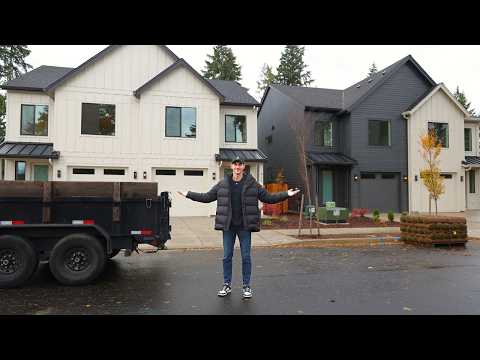
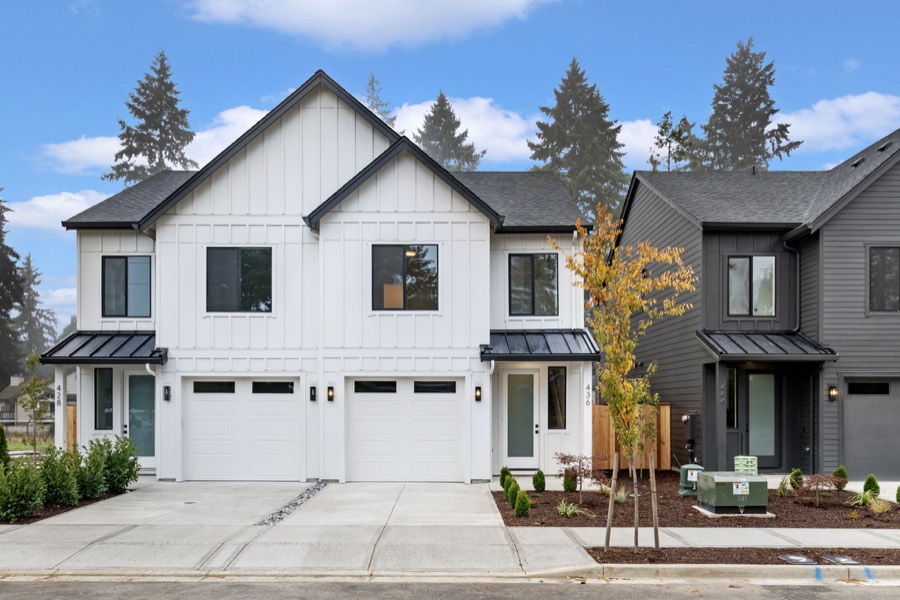
Arthur · 114 units
Location: Vancouver, WA
Farragut, Kenton, Ashley, Fircrest, Livingstone
Watch this project’s journey:
InstagramSee more on this project:
View the projectDay in the Life · Arthur the Developer
A day of site visits, plan reviews, and offers on active projects, plus a check in with a client build.
Full guide: Day in the Life →A real day: two job sites, two offers going out, and one floor plan in design. This is what running a development business actually looks like when you are not the builder, not the GC, and not on site every day.
Arthur visits each site about once a week for an hour, roughly four hours a month per project. He is not checking framing or inspections, and he does not want to be. He is looking for the things a builder or a sub will not catch, mostly design.
Example: the cabinet installer had spray painted the layout on the floor, a 2 foot island in a 900 square foot unit with a walkway so tight the entry door would nearly hit it. Arthur changed it to an L shaped peninsula with the sink out of the island, which opened room for a four chair dining table. Same square footage, same cabinet allowance, no change order, no additional cost. The unit feels twice as big.
Curb appeal matters during construction, not just at listing. The contract with every sub says they clean up after their work before the next trade starts, so the site always presents well. If there is a dumpster, it goes in the dumpster. If not, it goes in one pile for pickup. Nobody on the development side is picking up debris.
In a good market every developer makes money. In a bad market the real developers make money and the rest get washed out. Three buckets: land, build, sale, plus financing. Here is the Portland sixplex, walked through in full.
Land: a property worth $400,000 picked up at $275,000 (offered $15,000 over asking on a listing that was genuinely a deal), plus $5,000 closing and $50,000 of demolition. Fifty thousand sounds insane until you know Portland requires hand deconstruction of houses 100 years or older, and this one was 110 years old with asbestos to abate. Demo belongs in land basis, so land is $330,000.
Build: 5,500 square feet at $165 per foot is about $900,000, plus a 10% builder fee, so $990,000. Sale: units ranging $275,000 for the one bedroom, $315,000 to $320,000 for the two bedrooms, and near $400,000 for the three bedroom, so $1.8 to $1.95 million total. Finance: multiply land plus construction by 7.5% and you get roughly $99,000 covering interest, origination, lender closing costs, and appraisals.
Total cost lands at about $1.42 million. At the low sale end, after 5% agent fees, that is a 22% margin. At the high end, a net of $1.82 million against $1.42 million of cost is about a 32% margin.
Build the budget, agree on 10% cost plus, then convert it to a flat fee, $90,000 here, and sign that. The flat fee is deliberate: on a percentage, a builder who lets the budget drift to $1.3 million earns more. On a flat fee he does not.
Then invert the incentive entirely. Tell him that if he brings it in at $800,000 there is a $25,000 to $50,000 bonus. Incentivized, builders find the subs who need work right now and find ways to save that leave the product identical.
Builder grade means hardwood on the first floor, carpet on the stairs and up, 8 foot doors downstairs, 9 foot ceilings on both floors, oak cabinets, basic white countertops. For that product you should be between $100 and $175 per square foot. Around $100 in parts of Texas, $125 to $135 in Florida, $130 in Atlanta and Maryland, $160 in Michigan, $165 in Portland, $170 around Seattle, $175 in Sacramento. The nationwide average sits near $140. Lumber, siding, and foundation cost roughly the same everywhere; labor and permit fees are what move the number.
Anyone quoting over $200 a square foot for that spec is baking their profit into the price. Custom is different: floating staircases and imported marble genuinely cost more.
Arthur makes one to two offers a day. On an Alberta district fourplex: four units at 850 square feet, comped against attached two bed two bath product selling at $370,000 to $375,000. He underwrites conservatively at $360,000 per unit and $175 per square foot, with a 10% builder fee, 5.5% closing, 10% down, and about 12 months.
The owner wants $400,000 for the land, which returns 18% on conservative numbers. At $360,000 it is 23%. Arthur wants 25% to 30%, so he works backward to find that number: $315,000 hits 30%. So the offer goes out at $315,000, presented as a range of $305,000 to $320,000, with a target of landing at $330,000 to $340,000, which still holds 25%.
Rail only the bottom 3 or 4 steps rather than the full flight. Same look, roughly half the cost, multiplied across every unit in the building.
Never railing on the second floor. A half drywall wall costs effectively nothing and replaces a long, expensive railing run.
Large rocks instead of a formal block wall. About half the price, reads as intentional landscaping, saved roughly $5,000 on one project.
Add a door under the staircase. In a 950 square foot unit, storage is not optional.
A 14 foot ceiling over a 10 foot great room bumps up just enough for a chandelier and reads luxury. A full two story 20 foot volume reads like too much.
The electrical panel ended up in the living space on one unit. Painting it wall-white does not make it disappear. It will not kill the sale, but the standing instruction now is: bedroom, closet, garage, anywhere except a living space.
Mornings with family, then the office. Handle whatever moves a project across a finish line first, like closing out a plan set. Then answer members. Then underwrite deals and make offers. Site visits three days a week, usually two or three sites in a two hour window. Roughly 30% of the working week at home with the kids, 30% on job sites, 40% in the office.
When rates spiked, Arthur rented out projects, put some on short term rental platforms, and held them two to three years before selling. He still made a profit, because the 20% to 25% ROI rule left enough cushion to execute the second and third exit instead of the first. That is what the margin rule is actually for.
Ready to stop watching and start building?
Join the BuildUp Challenge and book a call with our team.
Join the BuildUp ChallengeWatch more on Arthur's channel.
Arthur visits each site about an hour a week, roughly four hours a month per project. He is not checking framing or inspections. He is looking for design issues a builder or sub would not flag, like a cabinet layout that makes a 900 square foot unit feel cramped.
For builder grade spec, $100 to $175 per square foot. Around $100 in parts of Texas, $125 to $135 in Florida, $130 in Atlanta and Maryland, $160 in Michigan, $165 in Portland, $170 near Seattle, $175 in Sacramento. The nationwide average is near $140. Lumber, siding, and foundation cost about the same everywhere; labor and permit fees move the number.
Build the budget on 10% cost plus, then convert it to a flat fee and sign that. On a percentage, a builder who lets the budget drift earns more. Then add an under-budget bonus, $25,000 to $50,000, so he is actively paid to find savings that do not change the product.
Work backward from your ROI target. On one fourplex, the owner wanted $400,000, which returned 18% on conservative numbers. Arthur found that $315,000 hit his 30% target, offered that as a range of $305,000 to $320,000, and aimed to land at $330,000 to $340,000, still inside a 25% return.
Rail only the bottom 3 or 4 steps instead of the full flight. Use a half drywall wall upstairs instead of railing. Use boulder retaining walls instead of formal block, about half the cost. And use a 14 foot ceiling over a 10 foot great room rather than a full two story volume, which reads more luxury anyway.
Nationwide
65+ active member builds, 300+ units in progress, across 20+ states. Click a market to see who is building there.
346
Units developing live
49
Markets

Location: Vancouver, WA
Farragut, Kenton, Ashley, Fircrest, Livingstone
Watch this project’s journey:
InstagramSee more on this project:
View the projectClick this market again for the next build here.
Your next step
New to development
A step-by-step challenge to line up your first deal, with our team beside you.
Join the ChallengeLive every week
Arthur and Ruben break down real deals and answer your questions in a live Q&A.
Join the live masterclassReady to build
Development consulting for people ready to put a real deal together now.
Explore consultingFree Resources
The templates, guides, and live sessions we hand every new member.
Real 2026 build costs for 43 US markets, from Arthur's own price map, with a live profit calculator.
Explore →Free PDFThe complete roadmap from land to sale, free.
Get it →Free AccessFree resources and every member story in one place.
Get it →Live WeeklyLive masterclass, weekly on Tuesdays. How to become a developer even with zero construction experience.
Get it →Free TemplateThe letter we use to reach lot owners directly, plus the training to use it.
Get it →Starter KitEverything you need to get moving on your first development, in one place.
Get it →Free CourseOur full 2.5-hour course on becoming a developer, land to exit, free on YouTube.
Get it →